
IFS and BRCGS audits
Which equipment does an IFS or BRCGS auditor check?
Most quality managers ask this three weeks before the audit. Here is the equipment involved, risk area by risk area, with the evidence the auditor will ask for.
 Lucens Integrity in 56 seconds
An IFS or BRCGS auditor does not judge your equipment. They judge your ability to prove it is under control. The equipment concerned falls into four risk areas: filtration and process, packaging, foreign body detection, and utilities. For each one the expected evidence is the same in principle: a dated record covering the whole audited period, and a documented response when a result is out of specification. A major non-conformity usually lands on a missing record or on a defect you cannot place in time, rarely on the defect itself.
The four risk areas and their equipment
This list covers equipment whose failure can reach the product. It applies to sites certified to IFS Food and BRCGS Food, meaning processing and manufacturing.
Filtration and process
This equipment holds back what must never reach the product. You will not see a failure by looking at it. It has to be tested.
- Liquid filters
- Membranes and cartridges on process water, milk, wine or syrups. Integrity is verified by bubble point or pressure drop, and the result has to be recorded.
- Air filters and vents
- HEPA filters and sterile tank vents. They protect against microbiological contamination of the air, in the processing room and on packing lines.
- Heat exchangers
- Plates and tubes. A micro-leak test demonstrates that heat-treated product and raw product are not mixing. It is one of the most closely examined points in pasteurisation.
Packaging
If seal integrity is not proven, the shelf life you print on the label becomes questionable, and so does the labelling itself.
- Sealers and tray sealers
- Peel strength and vacuum chamber leak testing, depending on the pack format. Records must cover the audited period, not just the day before the audit.
- Container rinsers and blowers
- Verification that debris is removed before filling, and that rinsing meets specification.
Foreign body detection
On this equipment, the auditor looks less at the hardware than at the verification log that goes with it.
- Metal detectors and X-ray systems
- Verification with certified test pieces: ferrous, non-ferrous and stainless steel, plus glass for X-ray. Frequency is set by your food safety plan, typically at start-up, at product changeover and at defined intervals. What the audit examines is the consistency of the records and what you do when a test fails.
- Sieves and mechanical filters
- Inspection of the mesh for tears. A torn sieve is a source of foreign bodies, and a missing inspection record is a finding in itself.
- Magnets
- Pull tests to confirm that magnetic strength is maintained, and records of the metal particles removed.
Utilities and environment
Because utilities never touch the product, they tend to disappear from control plans. Auditors ask for them anyway.
- Reverse osmosis and water treatment
- Conductivity monitoring tells you about membrane integrity. An unexplained drift is a signal, not a detail.
- Condensate traps and drains
- Standing water in a production area is favourable ground for Listeria monocytogenes. The check covers both operation and traceability.
What turns a finding into a major non-conformity
An experienced auditor compares what you claim to control with what you can actually show. Four situations tip a finding over:
- The record is missing for a period. Three weeks with no metal detector verification, and the auditor will ask what shipped during that time. A log filled in the night before is spotted just as fast: same pen, same handwriting, same day.
- A previous finding has no traceable follow-up. A contractor report flags a defect, and nothing shows what was decided or done. This is the most common case.
- The original report cannot be found. You state that the check took place. You cannot produce the document. To the auditor, those two situations are the same.
- The defect cannot be placed in time. Without history, you cannot say whether corrosion has been stable for two campaigns or is progressing. Neither can the auditor, and the auditor is the one who decides.
Rebuilding this evidence without losing a week
Your evidence already exists: inspection reports, contractor records, verification logs. It lives in network folders, binders and mailboxes, with nothing tying it to the asset it belongs to. That is where the days before an audit disappear.
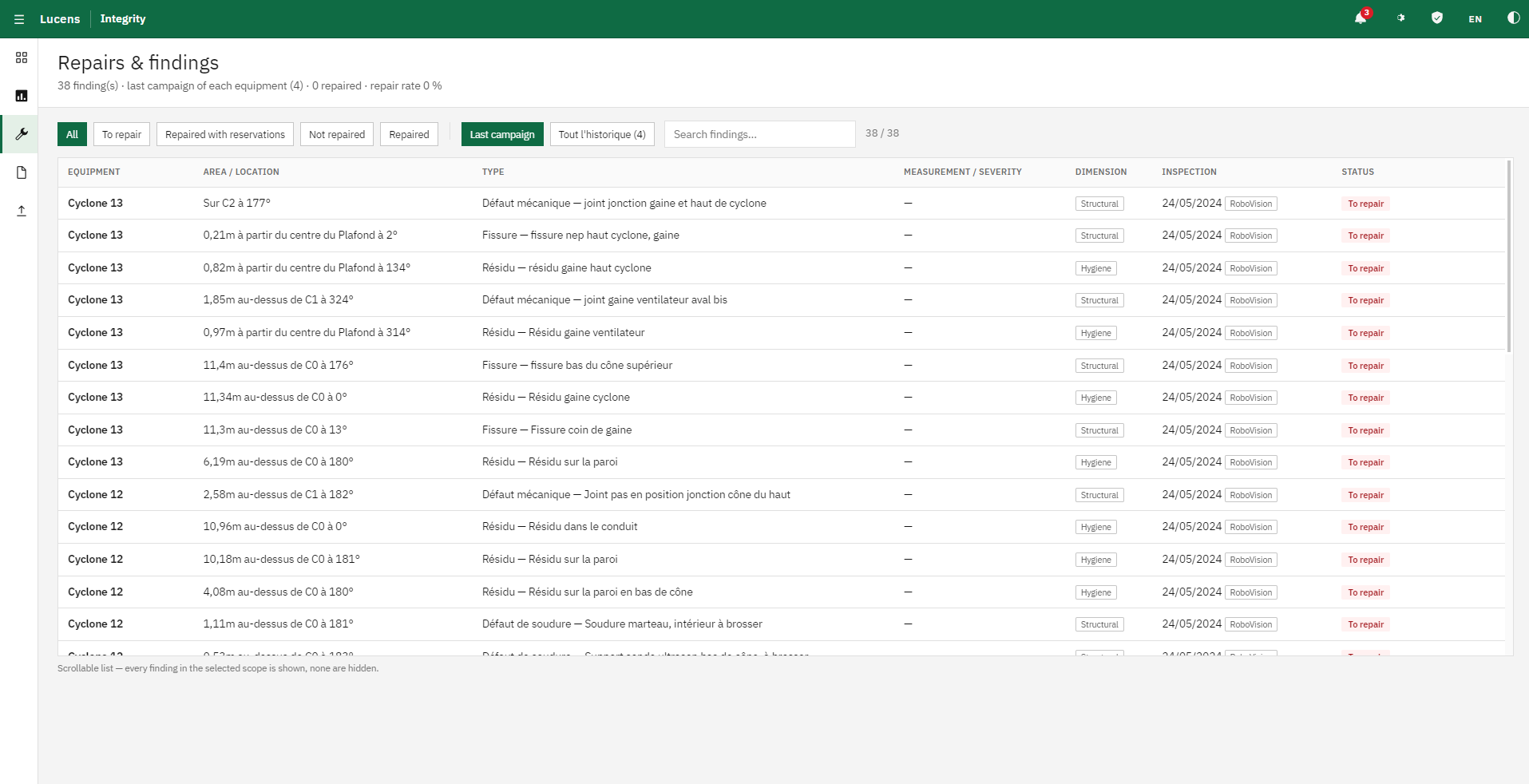
Lucens Integrity reads your inspection reports in PDF, locally, and rebuilds a single history for each asset: findings, how they evolve from one campaign to the next, due dates, and a link back to the original report. When the auditor asks for evidence on a given asset, it comes out by asset, with its source.
The software invents nothing. It transcribes what your contractors wrote, and flags formats it cannot read rather than guessing them.
Frequently asked questions
Which equipment is checked during an IFS or BRCGS audit?
The auditor checks equipment whose failure can reach the product: liquid and air filters, heat exchangers, sealers and tray sealers, metal detectors and X-ray systems, sieves, magnets, and utilities such as water treatment. What is assessed is your ability to prove that the integrity of each one is verified and recorded.
What evidence is required for a metal detector?
Verification records using certified test pieces, covering the whole audited period, at the frequency set by your food safety plan. The auditor also examines what happens when a test fails: identification of product back to the last passing test, hold, and a documented decision.
What turns a finding into a major non-conformity?
Rarely the defect itself. It is the missing evidence, a gap in the records, a previously raised finding with no traceable action, or an inability to retrieve the original report. A known defect that is monitored and documented can be discussed. A defect you cannot place in time cannot.
Do IFS and BRCGS ask for the same thing on equipment?
Both standards start from the same principle: you control what you can demonstrate. IFS Food and BRCGS Food cover processing and manufacturing, where this equipment sits. IFS Logistics and BRCGS Storage & Distribution cover warehousing and transport, and IFS Broker covers trading without physical handling, with different expectations on process equipment.
How long does it take to gather this evidence before an audit?
It depends on where your reports live. When inspection reports, contractor records and verification logs are scattered across network folders, binders and mailboxes, rebuilding the picture takes days of quality time. That delay is exactly what equipment-level integrity tracking removes.
Your next audit is prepared asset by asset.
We show you the software running on real inspection reports, and the history it rebuilds for every asset.
Book a demo